Amateur Satellite Communication

A complete visual lecture for Satathon participants: from basic satellite contacts to antennas, Doppler correction, TLE data, LoRa, TinyGS, and student satellite missions.

Print / Save PDF

Lecture Flow

This webpage collects the complete lecture content and visuals in order. It is designed as a post-event reference page for participants, allowing them to review concepts, revisit visuals, and follow the practical path toward making real satellite contacts.

FundamentalsCommunication ModesGround StationsTracking & TLEDopplerLoRa & TinyGSStudent Missions
01

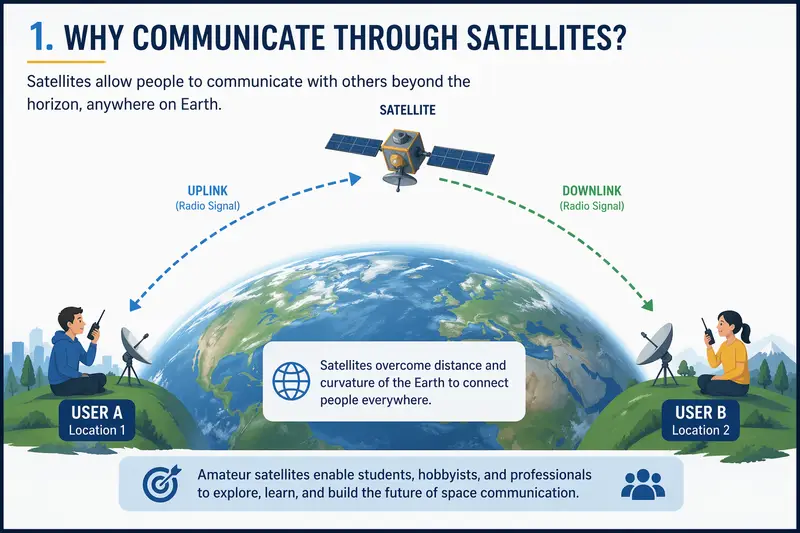
Why Communicate Through Satellites?

Satellites extend communication beyond the local horizon. They allow two distant users to connect through a radio relay in space.

Why Communicate Through Satellites? visual
Introduce the idea that amateur satellites make space communication accessible to students, hobbyists, and engineers.
02

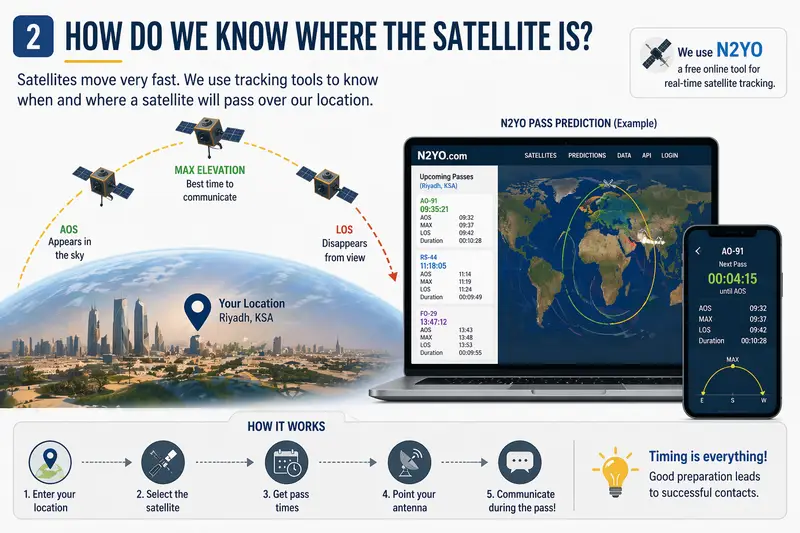
How Do We Know Where the Satellite Is?

Tracking tools such as N2YO help predict when and where a satellite will pass over a ground station.

How Do We Know Where the Satellite Is? visual
Timing is everything: a good pass prediction is the first step toward a successful contact.
03

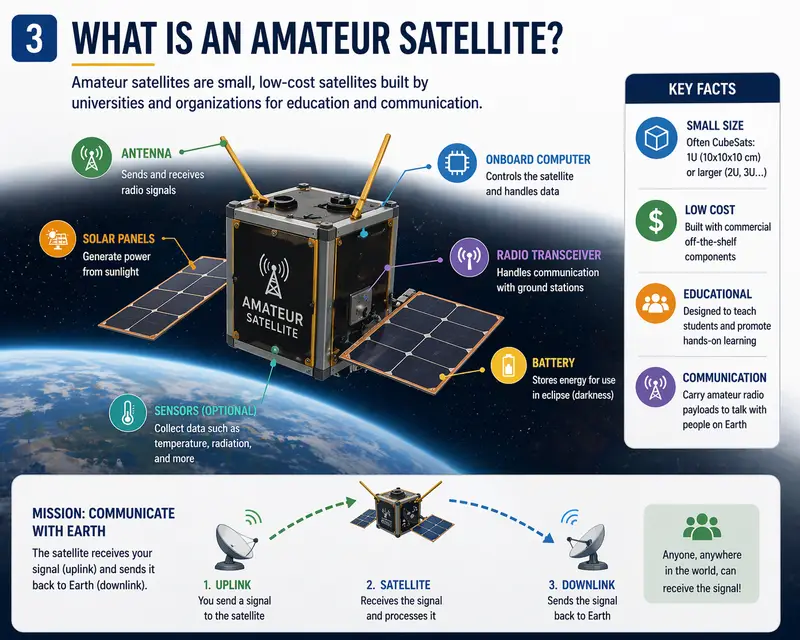
What Is an Amateur Satellite?

Amateur satellites are small educational satellites, often CubeSats, carrying radio payloads for communication, telemetry, and experimentation.

What Is an Amateur Satellite? visual
A small satellite can support real communication missions.
04

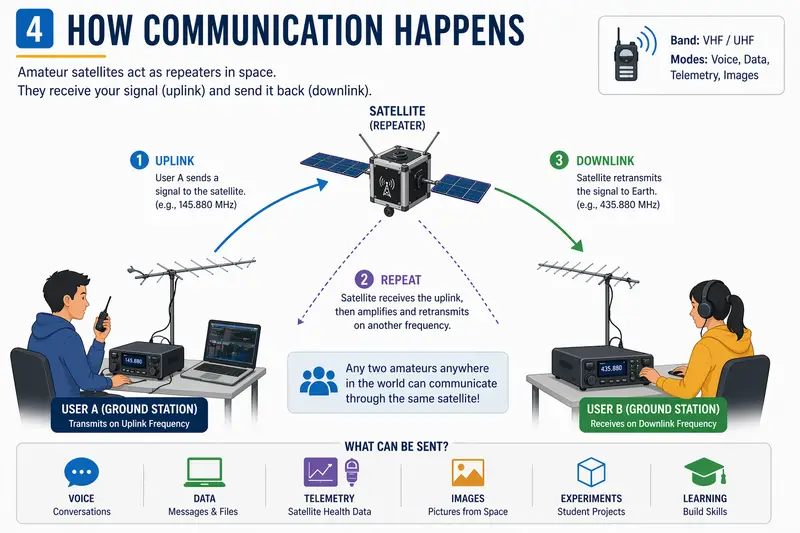
How Communication Happens

A ground station sends an uplink signal to the satellite. The satellite receives it and sends a downlink signal back to Earth.

How Communication Happens visual
The satellite acts like a repeater in space.
05

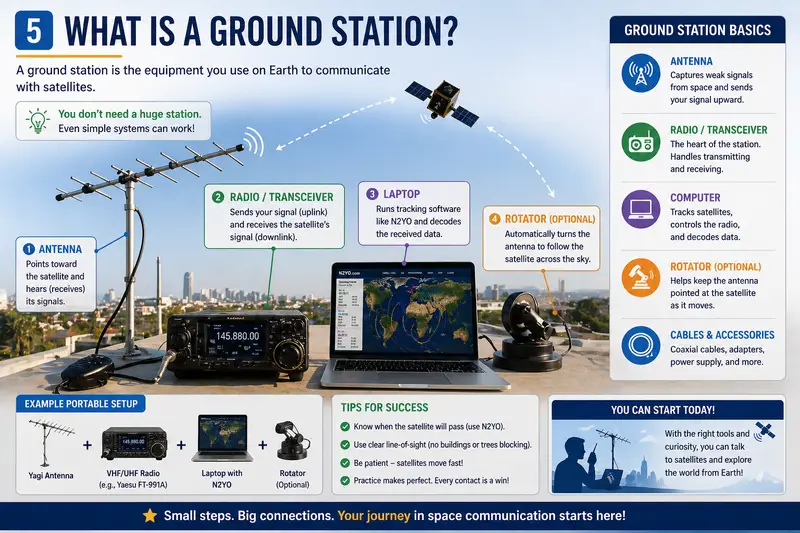
What Is a Ground Station?

A ground station combines an antenna, radio, computer, cables, and sometimes a rotator to communicate with satellites.

What Is a Ground Station? visual
You do not need a giant station to begin, but better equipment improves reliability.
06

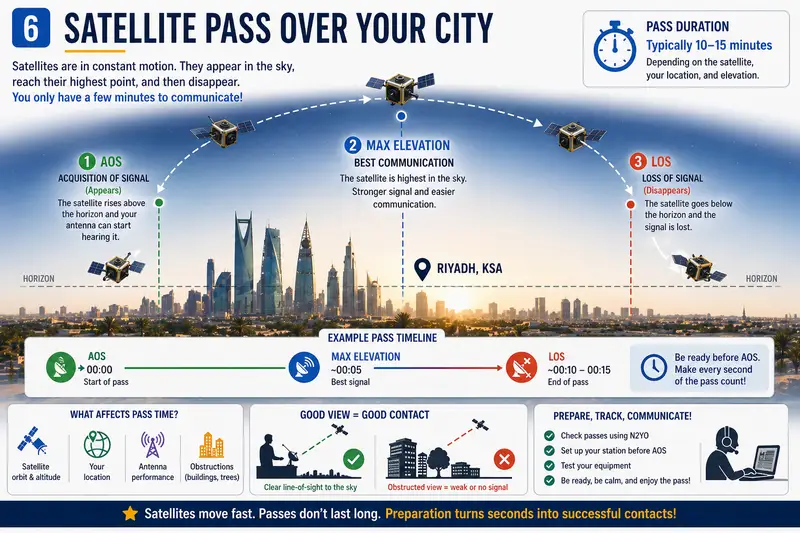
Satellite Pass Over Your City

LEO satellites appear above the horizon, reach maximum elevation, then disappear below the horizon. The contact window is short.

Satellite Pass Over Your City visual
Be prepared before AOS and use every minute of the pass.
07

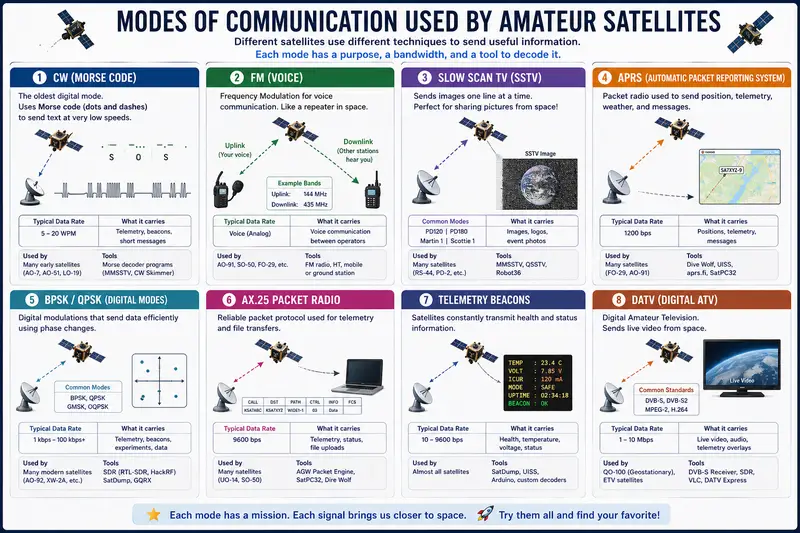
Modes of Communication Used by Amateur Satellites

Amateur satellites support many communication modes including CW, FM voice, SSTV, APRS, packet radio, telemetry, digital modulation, and DATV.

Modes of Communication Used by Amateur Satellites visual
Each mode has a purpose, bandwidth, and decoding method.
08

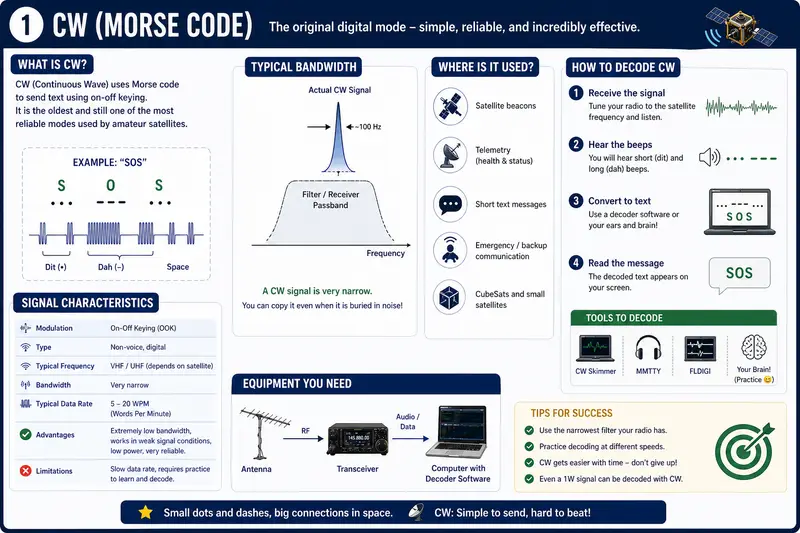
CW Morse Code

CW uses on-off keying to send Morse code. It is narrowband, reliable, and effective in weak-signal conditions.

CW Morse Code visual
Small dots and dashes can carry useful satellite messages.
09

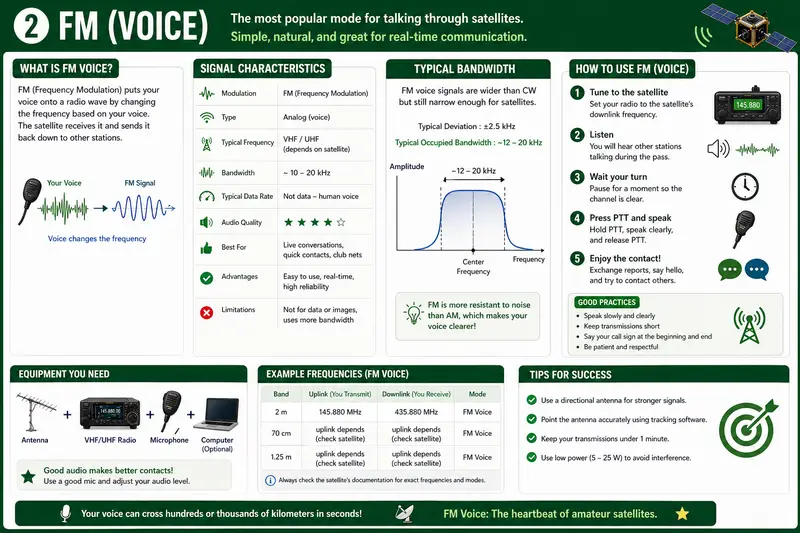
FM Voice

FM voice is the most intuitive satellite mode. Operators speak through an FM repeater satellite and exchange callsigns and signal reports.

FM Voice visual
FM is excellent for first live satellite contacts.
10

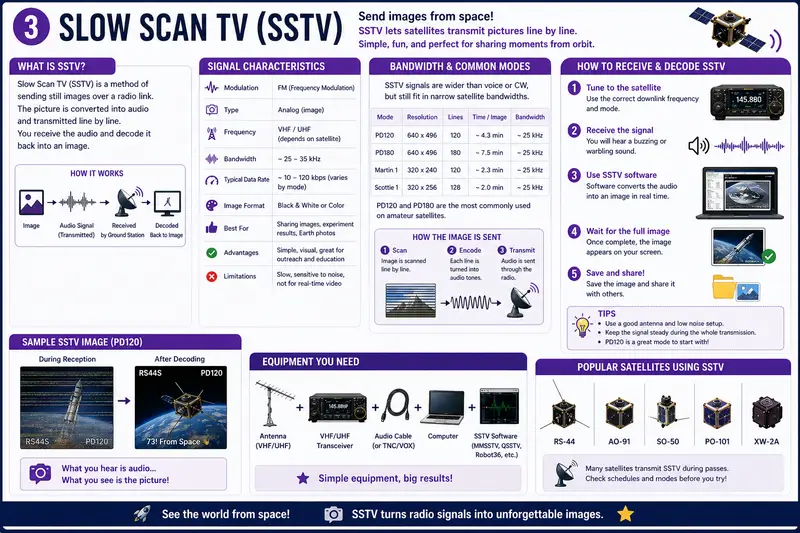
Slow Scan TV (SSTV)

SSTV sends still images by converting picture information into audio tones transmitted over radio.

Slow Scan TV (SSTV) visual
What you hear as audio becomes an image after decoding.
11

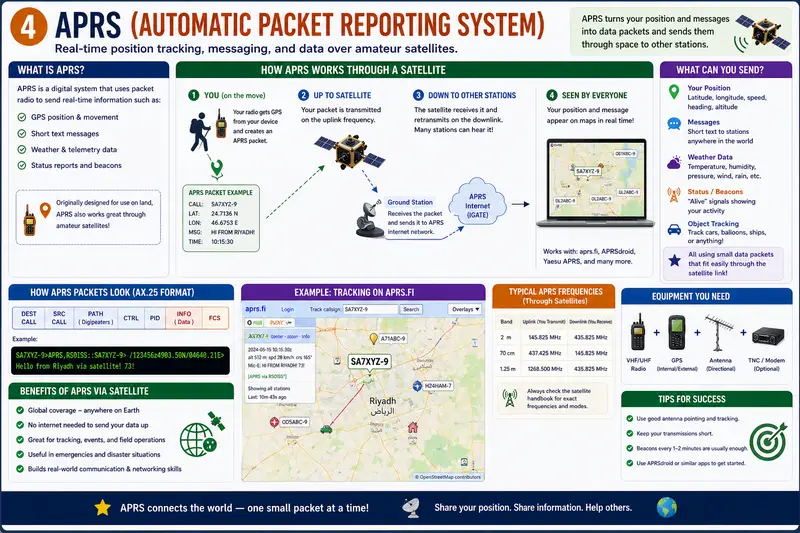
APRS Through Amateur Satellites

APRS sends position reports, short messages, telemetry, and status packets through satellites.

APRS Through Amateur Satellites visual
APRS turns small packets into useful real-time information.
12

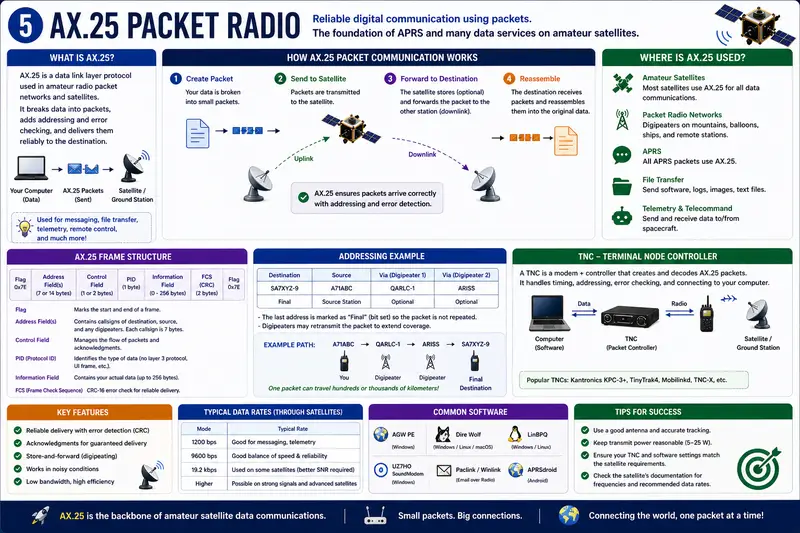
AX.25 Packet Radio

AX.25 is a packet radio protocol used for addressing, framing, and error checking in amateur data communications.

AX.25 Packet Radio visual
AX.25 is the backbone of many amateur satellite data services.
13

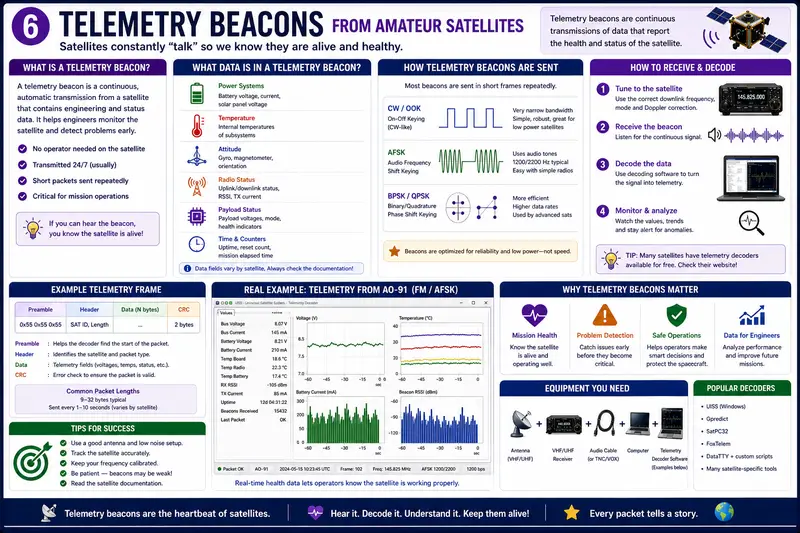
Telemetry Beacons

Telemetry beacons transmit satellite health and status data such as voltage, temperature, current, and payload state.

Telemetry Beacons visual
If you can hear the beacon, you know the satellite is alive.
14

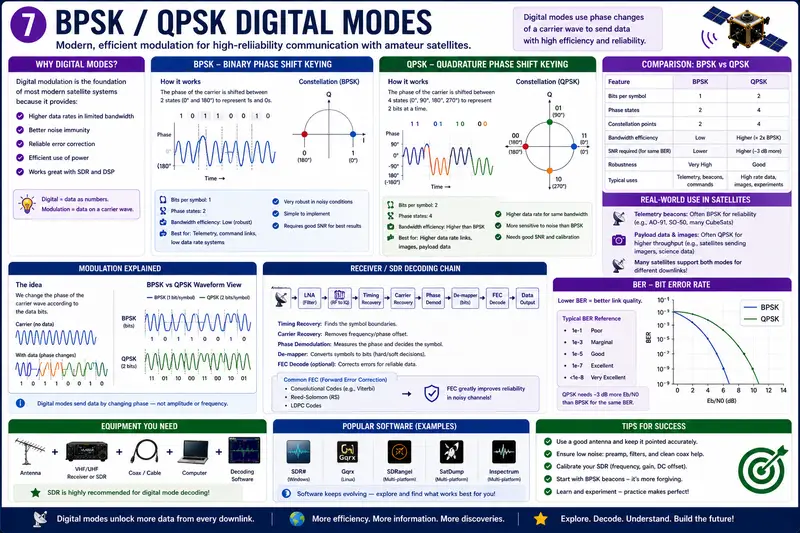
BPSK / QPSK Digital Modes

BPSK and QPSK send digital information by changing the phase of a carrier wave. They are important for efficient satellite data links.

BPSK / QPSK Digital Modes visual
Digital modes unlock more data from every downlink.
15

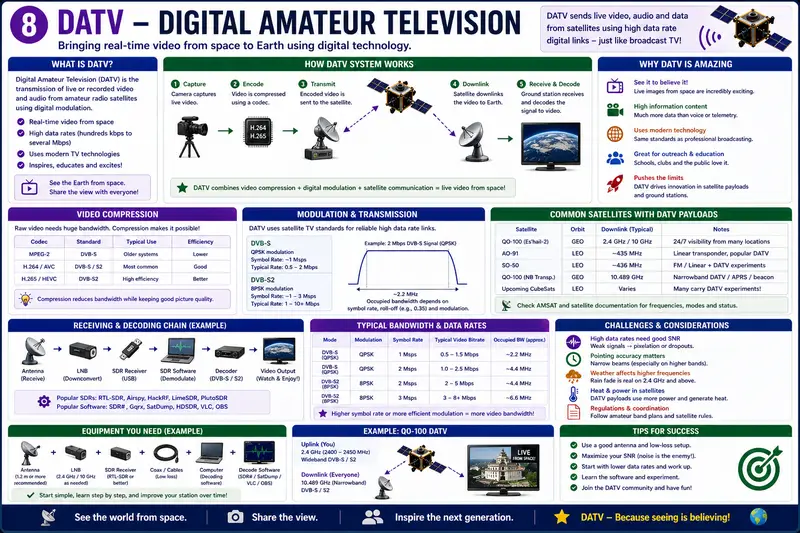
DATV – Digital Amateur Television

DATV transmits live or recorded video and audio using digital television techniques and higher data-rate links.

DATV – Digital Amateur Television visual
Seeing is believing: DATV brings video from space to Earth.
16

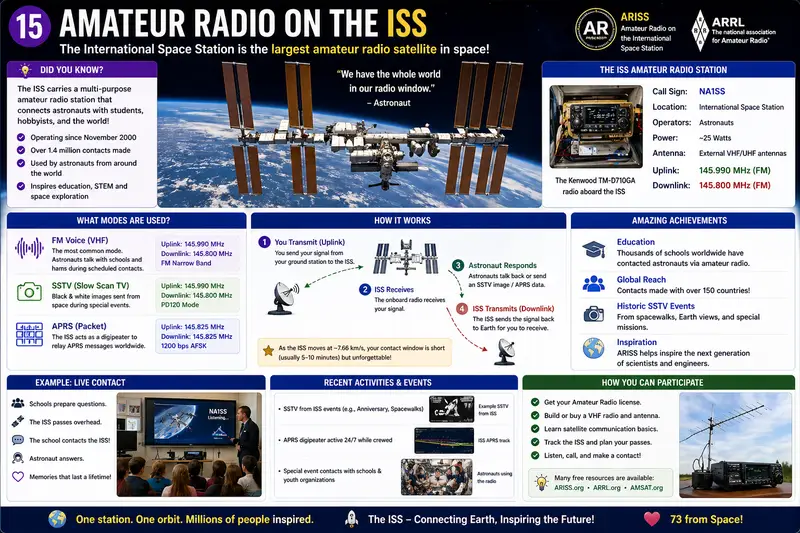
Amateur Radio on the ISS

The ISS carries amateur radio equipment used for school contacts, APRS, SSTV events, and educational outreach.

Amateur Radio on the ISS visual
The ISS shows how amateur radio can inspire millions.
17

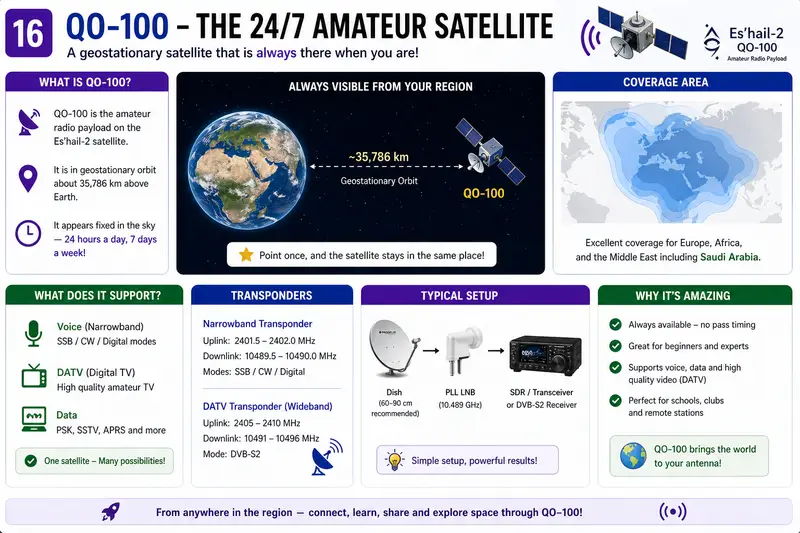
QO-100 – The 24/7 Amateur Satellite

QO-100 is a geostationary amateur radio payload that appears fixed in the sky and supports continuous operation over a wide region.

QO-100 – The 24/7 Amateur Satellite visual
Point once, and the satellite stays in the same place.
18

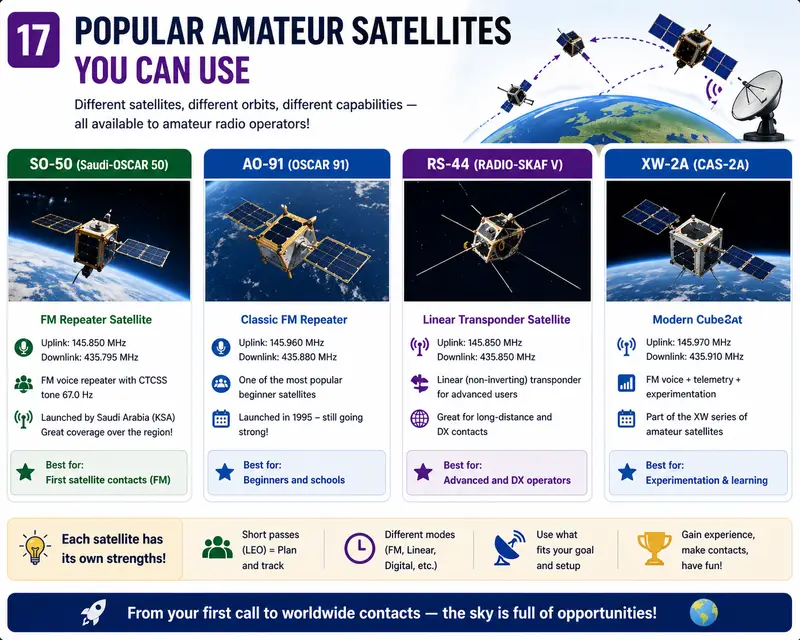
Popular Amateur Satellites You Can Use

Different amateur satellites support different orbits, bands, and modes. Operators choose satellites based on their goals and equipment.

Popular Amateur Satellites You Can Use visual
The sky is full of opportunities.
19

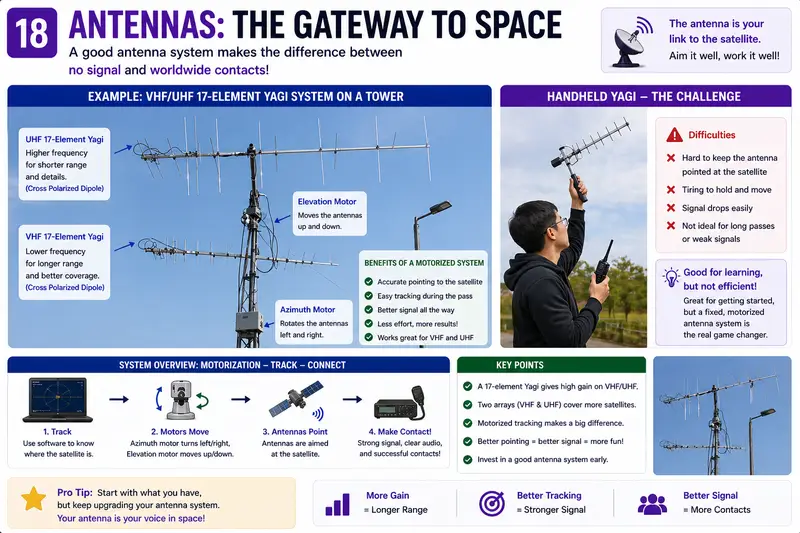
Antennas: The Gateway to Space

A VHF/UHF Yagi antenna system with azimuth and elevation control greatly improves pointing, gain, and contact reliability compared with a handheld antenna.

Antennas: The Gateway to Space visual
Better pointing means better signal.
20

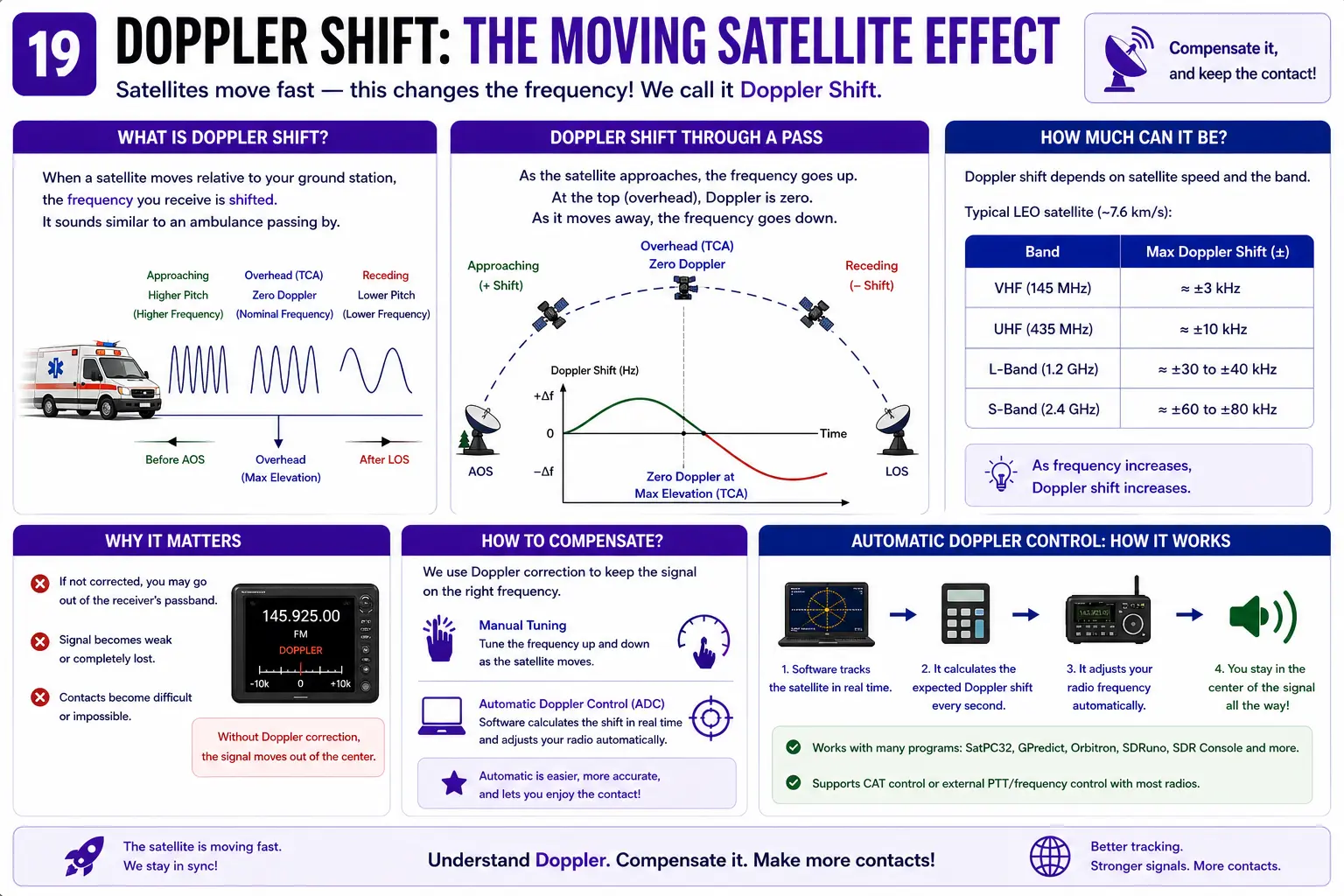
Doppler Shift: The Moving Satellite Effect

As a LEO satellite approaches, the received frequency shifts upward. At closest approach the Doppler shift crosses zero, then shifts downward as the satellite recedes.

Doppler Shift: The Moving Satellite Effect visual
Automatic Doppler correction keeps the signal centered.
21

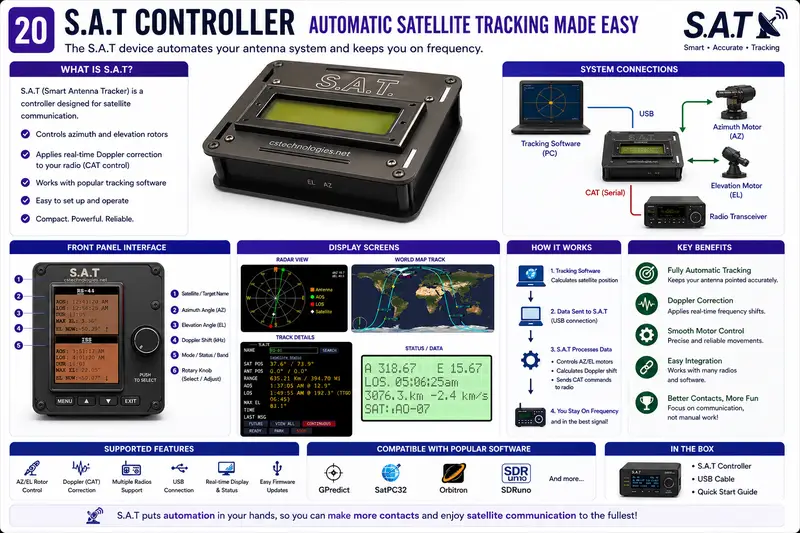
S.A.T Controller

The S.A.T controller automates antenna pointing and can support Doppler correction by connecting tracking software, rotators, and radio equipment.

S.A.T Controller visual
Automation lets the operator focus on the contact.
22

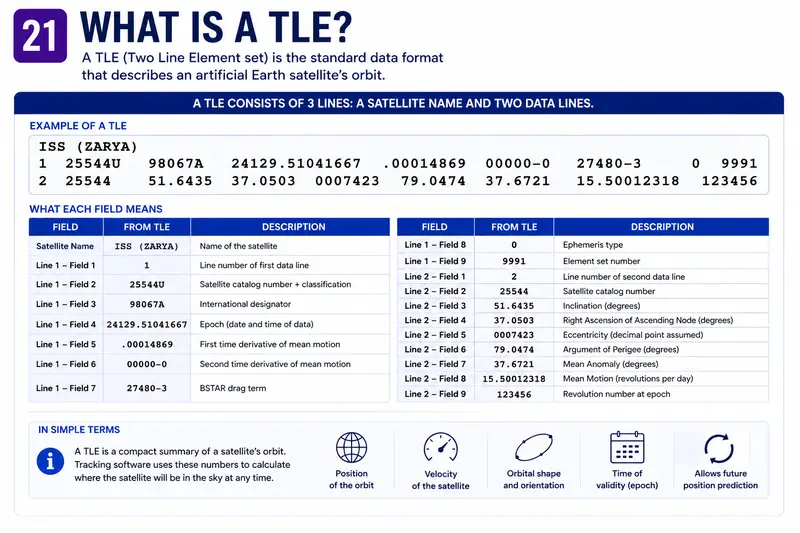
What Is a TLE?

A Two-Line Element set is a compact orbital data format that describes a satellite orbit and enables future position prediction.

What Is a TLE? visual
Tracking software needs TLEs to know where the satellite will be.
23

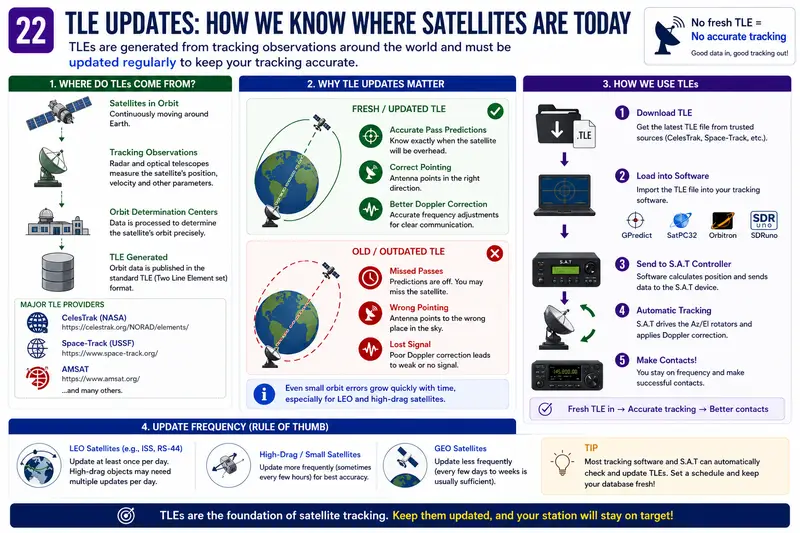
TLE Updates: How We Know Where Satellites Are Today

TLEs come from tracking observations and must be updated regularly so predictions, antenna pointing, and Doppler correction remain accurate.

TLE Updates: How We Know Where Satellites Are Today visual
Fresh TLE in means accurate tracking out.
24

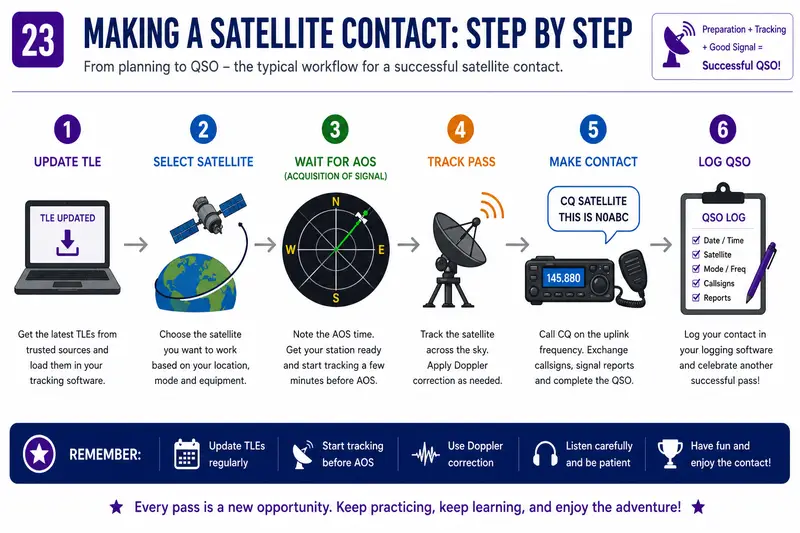
Making a Satellite Contact: Step by Step

A successful contact follows a workflow: update TLE, select satellite, wait for AOS, track the pass, make contact, and log the QSO.

Making a Satellite Contact: Step by Step visual
Preparation plus tracking plus good signal equals a successful QSO.
25

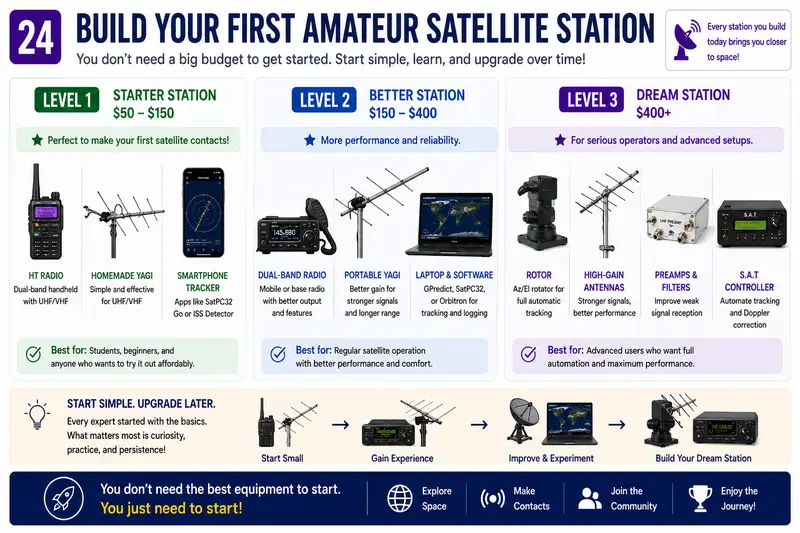
Build Your First Amateur Satellite Station

Students can start with a simple handheld radio, homemade Yagi, and smartphone tracker, then upgrade to radios, rotators, preamps, and automation.

Build Your First Amateur Satellite Station visual
Start simple. Upgrade later.
26

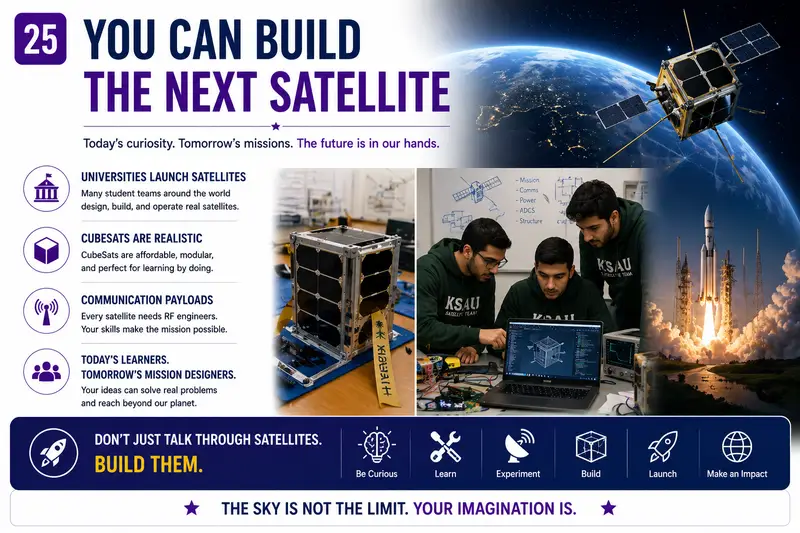
You Can Build the Next Satellite

CubeSats and student satellite projects make space engineering achievable. Communication payloads need RF engineers and creative mission designers.

You Can Build the Next Satellite visual
Do not just talk through satellites. Build them.
27

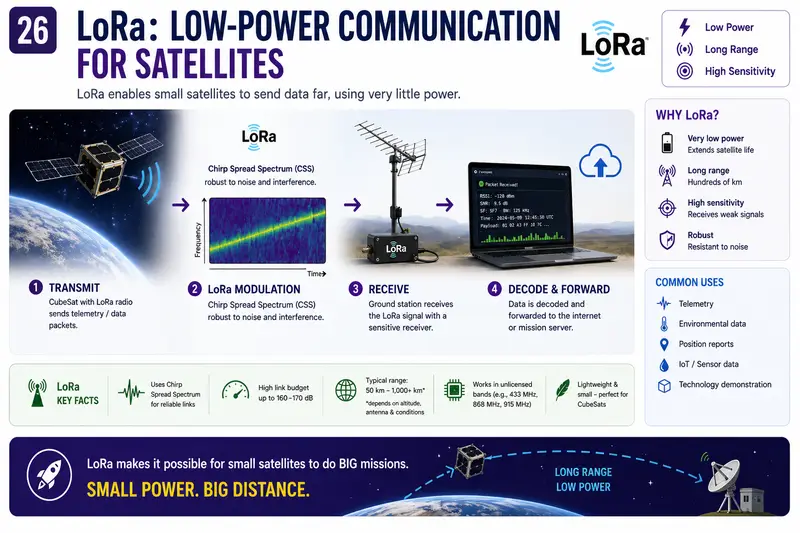
LoRa: Low-Power Communication for Satellites

LoRa enables small satellites to send low-power telemetry and data packets over long distances using chirp spread spectrum.

LoRa: Low-Power Communication for Satellites visual
Small power. Big distance.
28

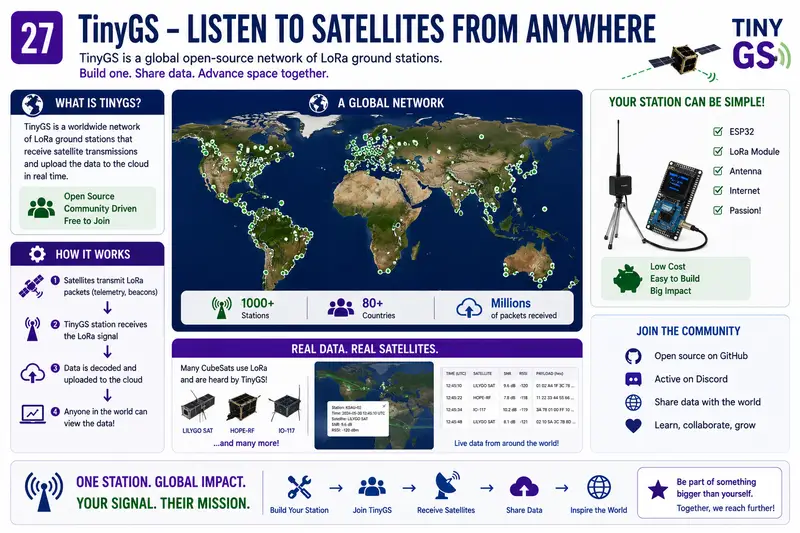
TinyGS – Listen to Satellites from Anywhere

TinyGS is a global open-source network of LoRa ground stations that receive satellite packets and share data online.

TinyGS – Listen to Satellites from Anywhere visual
One station can have global impact.
🛰️

Ready to Test Your Knowledge?

Take the mobile-optimized mission quiz to see if you're ready for your first satellite contact!

Launch Quiz Mission