Visual Concept Map
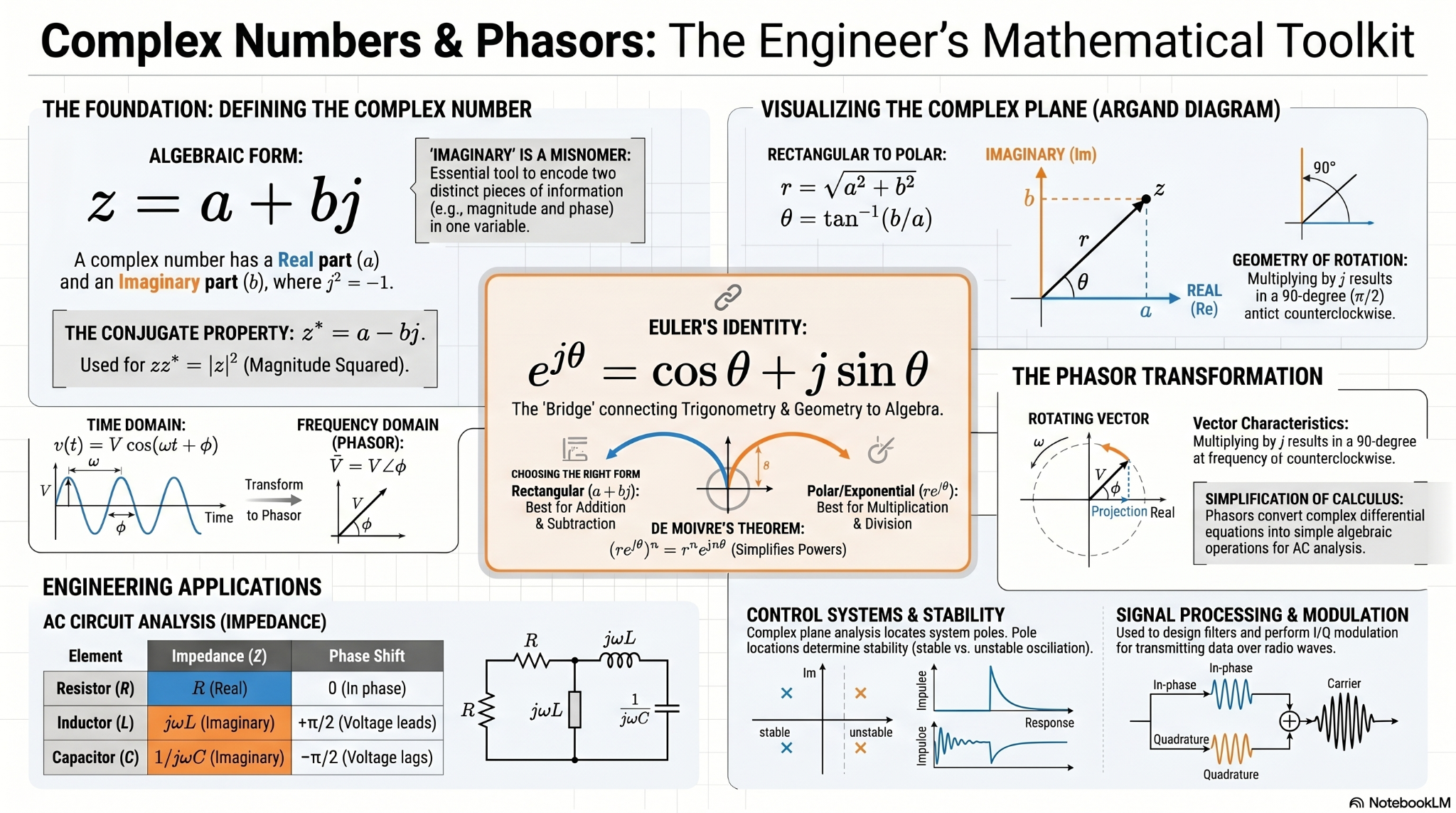
This one-page visual summarizes the main story: algebraic form, Argand diagram, Euler's identity, De Moivre's theorem, phasors, AC impedance, control systems, and modulation.
Lecture Overview
Motivation
Explain why engineers use complex numbers and how they encode magnitude and phase.
Representation
Write complex numbers in rectangular and polar forms and convert between them.
Operations
Perform addition, subtraction, multiplication, division, conjugation, powers, and roots.
Engineering Meaning
Use De Moivre's theorem and phasors to interpret sinusoidal signals and AC circuits.
1. Why Do We Need Complex Numbers?
Start with a simple equation:
There is no real number whose square is \(-1\). Therefore, we define:
Engineering Uses
- AC circuit analysis and impedance
- Phasors and sinusoidal steady-state analysis
- Signals, spectra, Fourier analysis, and modulation
- Control systems and stability analysis
- RF and communication systems: I/Q representation
The Central Bridge
This connects algebra, geometry, trigonometry, and engineering signals.
2. Forms of Complex Numbers
Rectangular Form
Where \(x\) is the real part and \(y\) is the imaginary part.
Good for: addition, subtraction, separating real and imaginary components.
Polar / Exponential Form
Where \(r=|z|\) is the magnitude and \(\theta=\arg(z)\) is the angle.
Good for: multiplication, division, powers, roots, and phasors.
Conversion Formulas
Rectangular to Polar
Polar to Rectangular
3. Arithmetic Operations
Addition and Subtraction
Best done in rectangular form.
Multiplication
Multiply magnitudes and add angles.
Division
Divide magnitudes and subtract angles.
Complex Conjugate
Geometrically, conjugation reflects the number across the real axis.
4. De Moivre's Theorem
The Theorem
Equivalently:
Example: Compute \((1+j)^4\)
First convert:
Then apply De Moivre:
5. Phasors: The Engineering Payoff
A sinusoidal signal can be represented using a complex exponential:
The time-independent part is called the phasor:
Why Phasors Are Powerful
- They turn sinusoidal functions into algebraic quantities.
- They simplify AC circuit analysis.
- They make phase differences easy to visualize.
Impedance Examples
Notice how \(j\) represents phase shift between voltage and current.
6. Sketching Complex Numbers
Sketching Steps
- Draw the real axis horizontally.
- Draw the imaginary axis vertically.
- Locate \(x\) on the real axis.
- Locate \(y\) on the imaginary axis.
- Draw the vector from origin to \((x,y)\).
- Mark magnitude \(r\) and angle \(\theta\).
Geometric Meanings
- \(z\): vector from origin
- \(|z|\): vector length
- \(\arg(z)\): angle from positive real axis
- \(z^*\): reflection across real axis
- \(ze^{j\theta}\): rotation by \(\theta\)
Interactive Examples
Experiment with the complex plane and rotating phasors to visualize the math.
Flashcards
Use these quick cards for active recall before taking the feedback quiz. Click the card to reveal the answer.
Feedback Quiz
Self-check quiz: rectangular and polar forms, operations, De Moivre's theorem, and phasors.
Progress: 0 / 15 answered
Full Answer Key
Review the correct answers and explanations below.
Resources for Students
Reference PDF
Open the complex numbers chapter reference used to support the lecture.
Concept Map
Review the full visual summary before solving practice problems.
Interactive Practice
Use the converter and phasor visualization to strengthen intuition.
Feedback Quiz
Check your mastery and receive immediate feedback.